
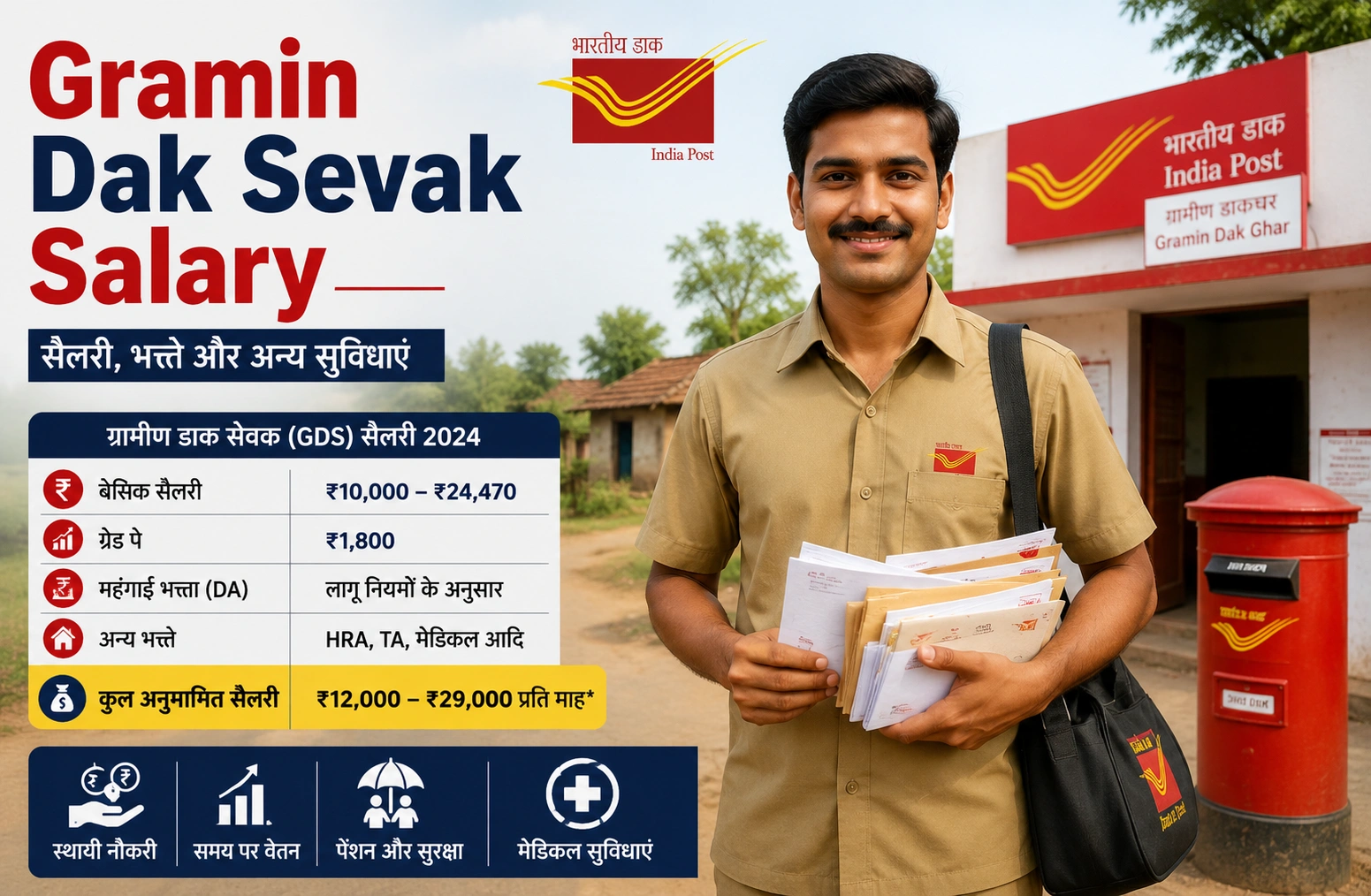
The Gramin Dak Sevak Salary 2026 starts from Rs. 10,000 per month for ABPM and Dak Sevak posts, and from Rs. 12,000 per month for Branch Postmaster (BPM) posts, with the maximum going up to Rs. 29,380 per month for BPM based on working hours and TRCA slabs.
If you have been searching for what is Gramin Dak Sevak Salary, how much does a GDS earn per month, or how the India Post GDS Salary structure works, you have come to the right place. This article gives you a complete, no-fluff breakdown of every aspect of the GDS Salary — from TRCA slabs and Dearness Allowance to annual packages, perks, job profiles, and career growth opportunities in 2026.
Disclaimer
The salary figures, TRCA slabs, DA rates, and other details mentioned in this article are based on available information as of 2026 and are meant for general guidance only. Actual pay may vary as per official notifications, circle-specific rules, and future revisions by the Department of Posts / Government of India. Readers are advised to verify the latest details from the official website (indiapost.gov.in).
Quick Stats: Gramin Dak Sevak Salary at a Glance (2026)
| Post | Monthly Salary (Starting) | Monthly Salary (Maximum) | Annual Package | Annual Package in LPA |
|---|---|---|---|---|
| Branch Postmaster (BPM) | Rs. 12,000 | Rs. 29,380 | Rs. 1,44,000 | 1.44 LPA |
| Asst. Branch Postmaster (ABPM) | Rs. 10,000 | Rs. 24,470 | Rs. 1,20,000 | 1.20 LPA |
| Gramin Dak Sevak / Dak Sevak | Rs. 10,000 | Rs. 24,470 | Rs. 1,20,000 | 1.20 LPA |
Note: The above salary figures are the basic TRCA pay. When Dearness Allowance (currently at 119% of basic pay) is added, the gross monthly take-home increases significantly.
What Is Gramin Dak Sevak Salary? Understanding the Basics
Before we dive into numbers, it helps to understand the system that governs the Gramin Dak Sevak Salary.
Unlike regular government employees who receive salaries based on a standard pay matrix, GDS employees are paid through a system called Time Related Continuity Allowance (TRCA). This is not a conventional salary but a fixed monthly allowance that depends on two factors: the post held by the employee and the number of working hours per day.
India Post GDS Gramin Dak Sevak Salary is structured for three types of posts:
- Branch Postmaster (BPM) — The senior post with higher TRCA
- Assistant Branch Postmaster (ABPM) — Mid-level post
- Dak Sevak — Engaged in departmental offices like Head Post Offices and Sub Post Offices
The Gramin Dak Sevak Salary 2026 is currently governed under the 7th Pay Commission framework, and experts expect the 8th Pay Commission to bring further revisions in the coming years.
The India Post, a statutory body functioning under the Ministry of Communications, Government of India, recruits GDS employees across 36 postal circles all over India. These employees form the backbone of rural postal services in the country.
Gramin Dak Sevak Salary Per Month: Post-wise Breakdown
Here is the exact Gramin Dak Sevak Salary per month for all three posts based on working hours:
GDS Monthly TRCA Salary Table (2026)
| Post | TRCA for 4 Hours Work | TRCA for 5 Hours Work |
|---|---|---|
| Branch Post Master (BPM) | Rs. 12,000 per month | Rs. 14,500 per month |
| Assistant Branch Post Master (ABPM) | Rs. 10,000 per month | Rs. 12,000 per month |
| Gramin Dak Sevak / Dak Sevak | Rs. 10,000 per month | Rs. 12,000 per month |
This is the base TRCA, which is the fixed portion of the GDS Salary per month. Over and above this, Dearness Allowance (DA) at 119% of basic pay is added, making the actual monthly take-home considerably higher.
For candidates wondering about the IPPB Gramin Dak Sevak Salary specifically — BPMs and ABPMs who handle India Post Payments Bank (IPPB) transactions also receive additional operational support allowances in certain circles, as managing IPPB banking work is part of their daily duty.
India Post GDS Salary Structure 2026: Detailed BPM Salary Breakdown
The Post Office GDS Salary structure for Branch Postmaster (BPM) varies based on the number of hours worked per day. Here is the complete breakdown including Basic Pay, Dearness Allowance (DA), Gross Salary, yearly Increment, Professional Tax (PTAX), and EDGIS contributions:
BPM Salary Structure by Working Hours
| Working Hours | Basic Salary | DA (119%) | Gross Salary | Annual Increment | PTAX | EDGIS |
|---|---|---|---|---|---|---|
| Up to 3 Hours | Rs. 2,045 | Rs. 3,261 | Rs. 6,012 | Rs. 50 | Rs. 110 | Rs. 50 |
| Up to 3 Hours 30 Minutes | Rs. 3,200 | Rs. 3,808 | Rs. 7,008 | Rs. 60 | Rs. 110 | Rs. 50 |
| Up to 4 Hours | Rs. 3,660 | Rs. 4,355 | Rs. 8,015 | Rs. 70 | Rs. 110 | Rs. 50 |
| Up to 5 Hours | Rs. 4,575 | Rs. 5,444 | Rs. 10,019 | Rs. 85 | Rs. 110 | Rs. 50 |
Key Note: DA is currently 119% of the basic salary component and is revised quarterly by the Government of India based on the Consumer Price Index.
India Post GDS Salary 2026: Annual Package Summary
The annual package for the GDS posts is clearly defined by the India Post Department. Here is what each post earns in a full year:
Post-wise Annual Salary (GDS Salary 2026)
| Post | Annual Salary | Annual Salary in LPA |
|---|---|---|
| Branch Post Master (BPM) | Rs. 1,44,000 | 1.44 LPA |
| Assistant Branch Post Master (ABPM) | Rs. 1,20,000 | 1.20 LPA |
| Gramin Dak Sevak (Dak Sevak) | Rs. 1,20,000 | 1.20 LPA |
The annual package includes the base TRCA and all applicable benefits. When DA, TRCA increments, and other allowances are factored in, the effective annual earnings are higher than the base package mentioned above. For a BPM working 5 hours per day with full DA and allowances, the gross annual package can reach approximately Rs. 2.30 to 2.50 LPA in 2026.
GDS Salary Per Month: In-Hand Take-Home Breakdown
Many candidates want to know exactly how much money gets credited to their bank accounts every month. Here is a simplified in-hand salary estimate for each post at the standard 4-hour working slab:
Estimated Monthly In-Hand Salary (GDS 2026)
| Post | Basic TRCA | DA (119% of Basic) | Gross Salary | Deductions (PTAX + EDGIS) | Approx. Net In-Hand |
|---|---|---|---|---|---|
| BPM (4 hours) | Rs. 12,000 | Rs. 3,660 (approx.) | Rs. 15,660 | Rs. 160 | Rs. 15,500 (approx.) |
| BPM (5 hours) | Rs. 14,500 | Rs. 4,424 (approx.) | Rs. 18,924 | Rs. 160 | Rs. 18,764 (approx.) |
| ABPM (4 hours) | Rs. 10,000 | Rs. 3,050 (approx.) | Rs. 13,050 | Rs. 160 | Rs. 12,890 (approx.) |
| ABPM (5 hours) | Rs. 12,000 | Rs. 3,660 (approx.) | Rs. 15,660 | Rs. 160 | Rs. 15,500 (approx.) |
| Dak Sevak (4 hours) | Rs. 10,000 | Rs. 3,050 (approx.) | Rs. 13,050 | Rs. 160 | Rs. 12,890 (approx.) |
The DA is applied on the basic component of the TRCA slab, and the precise calculation may vary slightly based on the applicable circle rules and the current DA rate notified by the government.
India Post GDS Salary Highlights 2026: Key Facts
| Parameter | Details |
|---|---|
| Conducting Authority | Department of Posts, Government of India |
| Posts Covered | BPM, ABPM, Dak Sevak |
| Minimum GDS Salary | Rs. 10,000 per month |
| Maximum BPM Salary Range | Rs. 12,000 to Rs. 29,380 |
| Maximum ABPM/Dak Sevak Range | Rs. 10,000 to Rs. 24,470 |
| Pay Basis | TRCA (Time Related Continuity Allowance) |
| DA Rate | 119% of basic pay (subject to revision) |
| Annual Increment | 3% of TRCA per year |
| Commission Basis | 7th Pay Commission (8th Pay Commission revision expected) |
| Official Website | indiapost.gov.in / appost.in/gdsonline |
| Total Vacancies (Latest Drive) | 44,228 vacancies |
Gramin Dak Sevak Salary 2026: Perks, Allowances and Benefits
One of the biggest reasons so many candidates target the India Post GDS Gramin Dak Sevak Salary is the full package of allowances and benefits that come along with the job. Apart from the basic TRCA, GDS employees are entitled to:
Time-Related Continuity Allowance (TRCA)
This is the primary component of the Post Office GDS Salary. The TRCA is determined by the post held and the daily working hours. It increases with annual increments.
Dearness Allowance (DA)
DA is currently at 119% of the basic pay. It is revised quarterly based on the All India Consumer Price Index (AICPI) to help employees deal with inflation. This revision significantly boosts the effective GDS Salary per month over time.
Annual Increment
GDS employees receive a 3% annual increment on their TRCA, subject to satisfactory service and the conditions outlined in the GDS Rules. This increment helps the salary grow steadily year after year.
Financial Upgradation Scheme
In March 2024, the Government of India announced a new Financial Upgradation Plan for over 2.56 lakh Gramin Dak Sevaks. Under this scheme, employees receive three upgrades at 12, 24, and 36 years of service:
- After 12 years: Additional Rs. 4,320 per year
- After 24 years: Additional Rs. 5,520 per year
- After 36 years: Additional Rs. 7,200 per year
This was a major step to address stagnation concerns and improve long-term earning potential for GDS employees.
Service Discharge Benefit Scheme (SDBS)
GDS employees benefit from the SDBS, which functions similarly to a Provident Fund. Both the employee and the government contribute to this scheme, which provides a lump-sum payment on retirement or discharge.
Gratuity
A one-time gratuity payment is made to GDS employees upon retirement, death, or discharge from service after completing the minimum qualifying period.
Medical Benefits
Limited medical coverage is extended to GDS employees as per government rules and departmental norms.
Paid Leave
GDS employees are eligible for casual leave and other sanctioned leave types during the year, making this a stable and employee-friendly job.
Office Maintenance Allowance (BPM Only)
Branch Postmasters receive an additional Office Maintenance Allowance since they are required to arrange accommodation for the Branch Post Office. This allowance helps cover operational and maintenance costs of the branch.
Cash Handling Allowance
GDS employees who regularly handle financial transactions and banking work, especially related to IPPB (India Post Payments Bank), may receive a Cash Handling Allowance in certain circles.
Gramin Dak Sevak Salary vs. Other Government Jobs: Comparison
Many candidates compare the India Post GDS Salary 2026 with other entry-level government job salaries before making their decision. Here is a simple comparison:
Salary Comparison: GDS vs Other Entry-Level Government Jobs (2026)
| Job Post | Starting Monthly Salary | Annual Package (LPA) | Qualification |
|---|---|---|---|
| GDS / BPM (India Post) | Rs. 12,000 | 1.44 LPA | 10th Pass |
| GDS / ABPM / Dak Sevak | Rs. 10,000 | 1.20 LPA | 10th Pass |
| SSC MTS | Rs. 18,000 (approx.) | 2.16 LPA (approx.) | 10th Pass |
| RRB Group D | Rs. 18,000 to Rs. 21,700 | 2.60 LPA (approx.) | 10th Pass |
| India Post Postal Assistant | Rs. 25,500 (approx.) | 3.06 LPA (approx.) | 12th Pass |
While the GDS Salary per month is lower than some comparable government jobs, the GDS role comes with important advantages: only a 10th pass qualification is required, the posting is local (in or near the candidate’s village), working hours are shorter (3 to 5 hours per day), and job security is backed by the Government of India.
India Post GDS Salary 2026: Job Profile and Responsibilities
Understanding the job duties tied to the Gramin Dak Sevak Salary is equally important. The GDS roles are divided into three posts, each with specific duties:
Branch Postmaster (BPM)
The BPM is the senior-most GDS post and handles:
- Day-to-day postal operations of the Branch Post Office including mail conveyance and delivery
- India Post Payments Bank (IPPB) transactions and banking services
- Marketing and promotion of products and services offered by the India Post Department
- Operating various services at Customer Service Centres (CSC) of the Department
- Overall responsibility for smooth functioning of the branch, including all mail activities
- Performing combined duties of ABPM when required, as ordered by supervising authorities
- Reporting to and following instructions from IPO/ASPO/SPOs/SSPOs and other senior officials
- Arranging accommodation for the Branch Post Office after selection, before engagement
Assistant Branch Postmaster (ABPM)
The ABPM works closely with the BPM and handles:
- Sale of stamps and stationery, door-to-door mail delivery
- IPPB deposits, payments, and other financial transactions using departmental devices
- Assisting Branch Postmasters in counter and operational tasks
- Marketing and business procurement activities of the Department
- Operating Customer Service Centre (CSC) services
- Performing BPM Combined Duty as and when ordered
- Following instructions from IPO/ASPO/SPOs/SSPOs and other superiors
- ABPM must reside within the delivery jurisdiction of the post office concerned
Dak Sevak
Dak Sevaks are engaged in Departmental offices like Head Post Offices (HO) and Sub Post Offices (SO). Their duties include:
- Sale of stamps and stationery; door-to-door mail and parcel delivery
- IPPB deposits, payments, and other banking transactions
- Working in sorting offices of the Railway Mail Service (RMS) when required
- Handling receipt and dispatch of mail bags, transhipment of bags in mail offices
- Assisting Postmasters/Sub Postmasters in smooth functioning of Departmental Post Offices
- Marketing, business procurement, and any other work assigned by superior authorities
- Must reside within the delivery jurisdiction of the concerned post office
IPPB Gramin Dak Sevak Salary: Role in India Post Payments Bank
A very common question asked by candidates is about the IPPB Gramin Dak Sevak Salary. It is important to clarify that IPPB (India Post Payments Bank) work is integrated into the regular duties of GDS employees, especially BPMs and ABPMs. They handle IPPB banking transactions, account openings, and financial service delivery as part of their core responsibilities.
There is no separate IPPB GDS Salary. However, GDS employees who perform IPPB-related work in certain circles may receive additional incentives or cash handling allowances based on departmental policy. The India Post GDS Salary remains under the TRCA framework even for IPPB-facing roles.
Gramin Dak Sevak Salary 2026: Career Growth and Promotion Opportunities
A concern that many GDS employees share is the limited promotion scope. Here is what the growth path looks like:
- GDS employees can be promoted to Postal Assistant or Sorting Assistant posts through Departmental Limited Competitive Examination (LDCE), which is conducted by the Department of Posts.
- Promotions depend on available vacancies, the employee’s service record, and performance in departmental examinations.
- The 2024 Financial Upgradation Scheme introduced three automatic upgrades at 12, 24, and 36 years of service, offering better earnings without waiting for promotions.
- With the 8th Pay Commission expected to revise GDS emoluments in the near future, salary growth prospects for Gramin Dak Sevak Salary 2026 employees look more positive than in previous years.
Gramin Dak Sevak Salary Growth Trend
| Year | BPM Starting TRCA | ABPM Starting TRCA | DA Rate (Approx.) |
|---|---|---|---|
| 2020 | Rs. 10,000 | Rs. 8,000 | 17% |
| 2022 | Rs. 12,000 | Rs. 10,000 | 38% |
| 2024 | Rs. 12,000 | Rs. 10,000 | 50%+ |
| 2026 | Rs. 12,000 | Rs. 10,000 | 119% |
While the base TRCA has remained the same since 2022 revision, the effective salary has grown significantly because of the DA increase from 17% in 2020 to 119% in 2026. This means a BPM who earned around Rs. 11,700 gross in 2020 now earns close to Rs. 15,500 to Rs. 18,000 gross per month in 2026, simply due to DA revisions.
Tax and Lifestyle Impact of GDS Salary
The GDS Salary per month falls well below the basic income tax exemption limit of Rs. 2.5 lakh to Rs. 3 lakh per year (depending on the regime chosen). This means:
- Most GDS employees do not pay income tax on their GDS salary
- The net take-home salary is very close to the gross salary
- The PTAX (Professional Tax) deduction is only Rs. 110 per month in most states
- EDGIS (Extra Departmental Group Insurance Scheme) deduction is Rs. 50 per month
For candidates in rural areas where the cost of living is lower, the Post Office GDS Salary of Rs. 12,000 to Rs. 18,000 per month provides a stable and respectful livelihood, especially since the posting is usually local, reducing commute costs entirely.
Expert Insight: Is the GDS Job Worth It in 2026?
Based on the current India Post GDS Salary 2026 data, here is an honest assessment:
Pros:
- Government job security, even though GDS is not a regular central government employee post
- Only 10th pass qualification required, making it accessible to a large section of rural candidates
- Local posting, so no relocation cost or long commute
- Shorter working hours (3 to 5 hours per day) leave time for other work
- DA revisions regularly increase effective earnings
- Financial Upgradation at 12, 24, and 36 years of service adds long-term value
- Gateway to Postal Department promotions through LDCE
Cons:
- Base TRCA has not seen a significant revision since 2022
- No House Rent Allowance (HRA) in the same way regular government employees receive
- Promotion path is limited and competitive
- 8th Pay Commission revision is still awaited
For a rural candidate looking for a stable, government-backed income close to home, the Gramin Dak Sevak Salary 2026 offers a fair and reliable package.
Conclusion: Key Takeaways on Gramin Dak Sevak Salary 2026
Here is a quick summary of everything you need to know about the GDS Salary in 2026:
- The Gramin Dak Sevak Salary starts at Rs. 10,000 per month for ABPM and Dak Sevak, and Rs. 12,000 per month for BPM under the 4-hour TRCA slab.
- The maximum BPM salary can go up to Rs. 29,380 per month, and for ABPM it can reach Rs. 24,470 per month.
- The annual package for BPM is Rs. 1,44,000 (1.44 LPA) and Rs. 1,20,000 (1.20 LPA) for ABPM and Dak Sevak.
- Dearness Allowance (DA) at 119% of basic pay significantly boosts the monthly take-home above the base TRCA.
- GDS employees receive a 3% annual increment on their TRCA.
- The Financial Upgradation Scheme (2024) provides salary boosts at 12, 24, and 36 years of service.
- The India Post GDS Salary 2026 is based on the 7th Pay Commission, with 8th Pay Commission revisions expected.
- IPPB duties are part of the regular job profile for BPM and ABPM posts, with no separate IPPB GDS Salary.
- GDS employees can grow into Postal Assistant roles through the Departmental LDCE examination.
The GDS job remains one of the most popular and accessible government employment options in rural India, especially for 10th pass candidates seeking job security and local postings.
Read More:
- payscaleinfo
- Nirmala Sitharaman Salary
- 5.5 LPA In Hand Salary
- 3 LPA in Hand Salary
- Loco Pilot Salary
- 2 LPA In Hand Salary
- IBPS Law Officer Salary
- Level 3 Pay Scale
- 4.5 LPA In Hand Salary
- 8th Pay Commission Salary Hike
- 3.6 LPA In Hand Salary
- 4 LPA In Hand Salary
- Merchant Navy Salary
Frequently Asked Questions
Q1. What is the Gramin Dak Sevak Salary per month in 2026?
Starts at ₹10,000 (ABPM/Dak Sevak, 4 hrs) and ₹12,000 (BPM). For 5 hrs: ₹12,000 (ABPM) and ₹14,500 (BPM). With DA (119%), gross take-home is higher.
Q2. What is the maximum GDS salary?
₹29,380 per month for BPM and ₹24,470 for ABPM/Dak Sevak (upper end of TRCA slab).
Q3. What is the GDS annual salary in LPA?
Approx. 1.44 LPA for BPM and 1.20 LPA for ABPM/Dak Sevak. Gross with DA can be higher.
Q4. What is TRCA?
Time Related Continuity Allowance – the fixed monthly pay based on post and working hours. GDS get 3% annual increment on TRCA.
Q5. What is the IPPB GDS Salary?
No separate IPPB salary. BPM/ABPM handle IPPB work under regular TRCA. Some circles may give extra incentives.
Q6. Does GDS salary increase every year?
Yes – 3% annual TRCA increment + quarterly DA revision. Financial Upgradation Scheme adds extra amounts at 12, 24 & 36 years of service.
Q7. Is there any tax on GDS salary?
Usually no (falls under tax exemption limit). Only small deductions like Professional Tax (₹110) and EDGIS (₹50) per month.
Q8. Can a GDS get promoted?
Yes – through LDCE exam to Postal/Sorting Assistant. Also possible within GDS grade based on seniority/vacancies.
Q9. What is the GDS salary for different working hours?
BPM: ₹12,000 (4 hrs) / ₹14,500 (5 hrs) ABPM/Dak Sevak: ₹10,000 (4 hrs) / ₹12,000 (5 hrs)
Q10. What qualification is needed?
Class 10th (Matriculation) pass from a recognized board.
Thank you for reading this comprehensive guide on Sanket Upadhyay .
