
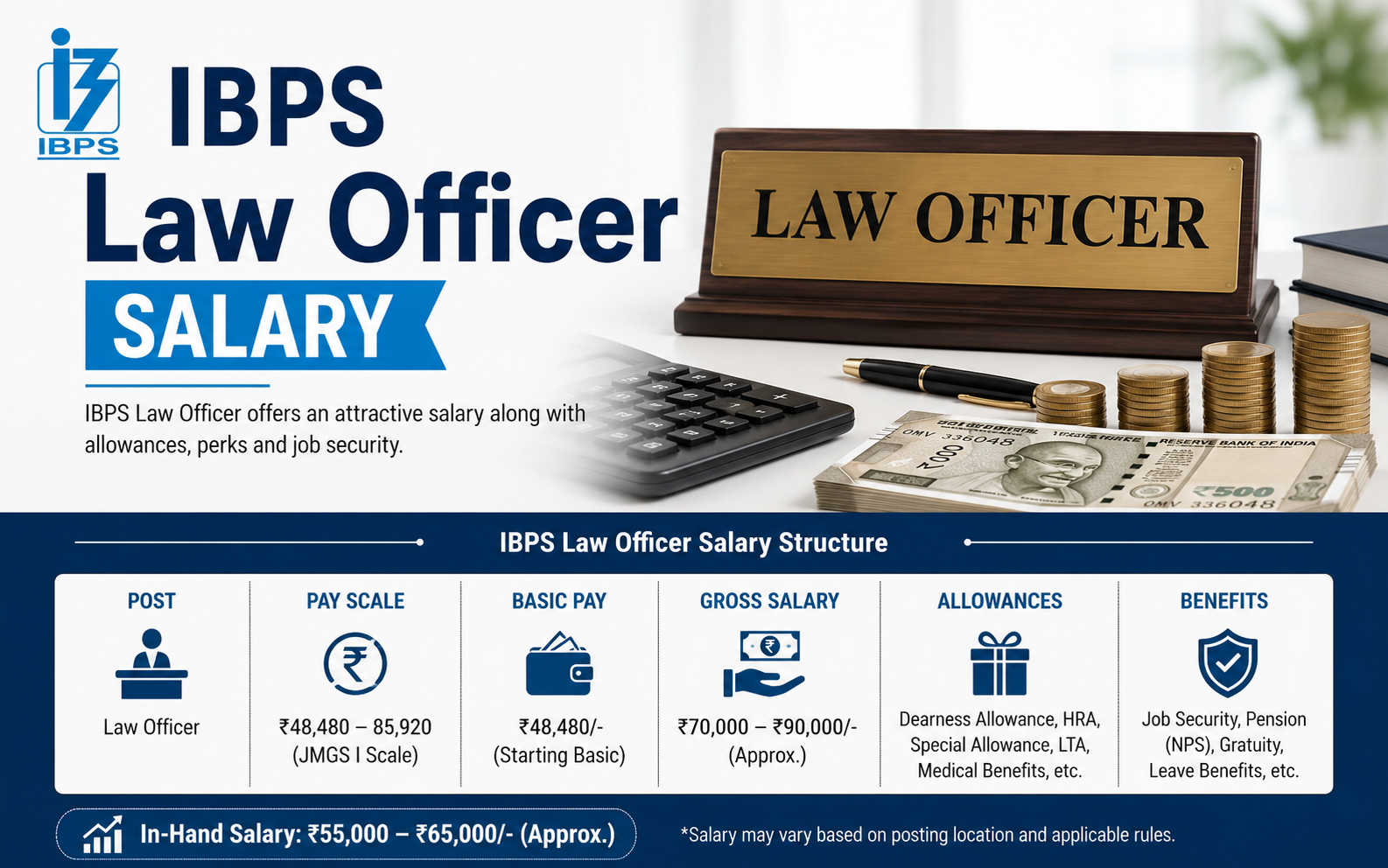
So, you’ve been grinding through legal textbooks, survived law school, and now you’re eyeing the IBPS Law Officer salary post. Smart move. But before you dive headfirst into preparation, the most practical question you’re probably asking yourself is: “How much will I actually earn?”
Fair enough. You deserve a straight, no-nonsense answer — not buried under ten paragraphs of filler. Let’s fix that right now.
IBPS Law Officer at a Glance: Quick Stats Table
| Detail | Information |
|---|---|
| Conducting Body | Institute of Banking Personnel Selection (IBPS) |
| Post Name | Law Officer (Specialist Officer – Scale I) |
| Starting Basic Pay | ₹48,480/month |
| Gross Monthly Salary | ₹65,000 – ₹78,000/month |
| In-Hand (Take-Home) Salary | ₹60,000 – ₹71,000/month |
| Pay Scale | ₹48,480–2,000/7–62,480–2,340/2–67,160–2,680/7–85,920 |
| Vacancies (2026) | 105 Posts |
| Eligibility | LL.B / BA LL.B + Enrolled as Advocate with Bar Council |
| Age Limit | 20–30 Years |
| Selection Process | Prelims → Mains → Interview |
What Is the IBPS SO Law Officer Salary Structure?
Let’s break this down as simply as possible — think of your total pay as a sandwich. The basic pay is the bread, the allowances are the fillings, and the deductions? That’s the part that shrinks your bite.
Basic Pay
The starting basic pay for the IBPS SO Law Officer post is ₹48,480 per month. This is your foundation — everything else is calculated on top of it.
The official IBPS SO Scale I pay scale runs from ₹48,480 → ₹85,920, with the basic pay rising gradually through annual increments over the course of the officer’s service.
That means you don’t stay at ₹48,480 forever. Every year, your basic pay goes up automatically. No begging, no negotiating — it’s baked into the structure.
Gross Salary vs. In-Hand Salary
Here’s where a lot of people get confused, so let’s be clear:
The gross salary ranges between ₹65,000 to ₹78,000 per month, depending on the posting location. The in-hand salary is approximately ₹60,000 to ₹71,000 per month after deductions like tax and NPS.
So the gross salary is what’s on paper. The in-hand salary is what actually lands in your bank account.
Complete IBPS Law Officer Salary Breakdown (2026)
| Component | Amount (Approx.) |
|---|---|
| Basic Pay | ₹48,480 |
| Dearness Allowance (DA) | ~36% of Basic Pay ≈ ₹17,452 |
| House Rent Allowance (HRA) | 7% – 9% of Basic Pay (city-wise) |
| Special Allowance | Included in gross |
| City Compensatory Allowance (CCA) | Based on posting city |
| Travel Allowance | Provided |
| Medical Reimbursement | Provided |
| Gross Monthly Salary | ₹65,000 – ₹78,000 |
| Deductions (PF + Tax + NPS) | ~₹5,000 – ₹8,000 |
| In-Hand Salary | ₹60,000 – ₹71,000 |
Disclaimer: Exact figures may vary slightly based on the bank you are posted to, the city tier, and quarterly DA revisions. Always refer to the official IBPS notification and your bank’s HR department for confirmed figures.
What Allowances Does an IBPS SO Law Officer Get?
Here’s where the job really starts to look attractive. Your IBPS Law Officer salary isn’t just about the basic pay — the allowances significantly pad your monthly earnings.
Officers receive benefits like DA, HRA, medical perks, and allowances. DA is revised quarterly based on the Consumer Price Index to manage inflation. HRA ranges from 7% to 9% of the basic pay depending on the city tier.
IBPS Law Officers also receive Special Allowance, Travel Allowance, Medical Reimbursement, Newspaper Allowance, Furniture Allowance, Overtime Allowance, and Leave Travel Concession.
Let’s lay all of that out cleanly:
Allowances at a Glance
| Allowance | What It Covers |
|---|---|
| Dearness Allowance (DA) | Inflation buffer – revised every quarter |
| House Rent Allowance (HRA) | 7–9% of basic pay based on city tier (X/Y/Z) |
| Special Allowance | Fixed additional pay |
| City Compensatory Allowance | Extra pay for expensive cities |
| Travel Allowance | Daily or monthly commute support |
| Medical Reimbursement | Health expenses for self and family |
| Newspaper Allowance | Yes, newspapers are covered! |
| Furniture Allowance | One-time or periodic benefit |
| Leave Travel Concession (LTC) | Travel expenses for annual leaves |
| Overtime Allowance | For extra hours when required |
How Does City of Posting Affect Your IBPS Law Officer Salary?
Great question — and honestly, this is something most people overlook.
Your HRA and CCA aren’t fixed numbers. They depend on whether you’re posted in a metro city (Class X), a smaller urban area (Class Y), or a rural or semi-urban zone (Class Z).
| City Category | HRA as % of Basic Pay | Examples |
|---|---|---|
| Class X (Metro) | 9% | Mumbai, Delhi, Kolkata, Chennai |
| Class Y (Urban) | 8% | Jaipur, Lucknow, Nagpur, Indore |
| Class Z (Semi-Urban/Rural) | 7% | Smaller towns, rural postings |
So, an IBPS SO Law Officer in Mumbai will take home a bit more than one posted in a Class Z city — not because they work harder, but because the city factor inflates the allowances.
Deductions: What Gets Cut From Your IBPS Law Officer Salary?
Nobody loves this part, but ignoring it would be dishonest. Here’s what gets deducted monthly:
After deductions, the IBPS SO law officer salary a candidate takes home ranges between ₹60,000 and ₹71,000. Deductions typically include Provident Fund, Professional Tax, and Income Tax, which are standard for government jobs.
| Deduction | Nature |
|---|---|
| Income Tax (TDS) | Depends on your tax slab |
| Professional Tax | State-level deduction |
| National Pension System (NPS) | ~10% of basic pay |
| Provident Fund (PF) | Standard PF deduction |
Here’s a pro tip: The NPS and PF deductions are not lost money. They’re building your long-term retirement corpus. So while they shrink your monthly take-home, they’re essentially forced savings working for your future self.
IBPS SO Law Officer vs. Other Specialist Officer Posts: Salary Comparison
A very common question is: “Is the IBPS Law Officer salary the same as other SO posts like IT Officer or HR Officer?”
All IBPS SO posts — namely, IT, Law, HR, Marketing, Agriculture, and Rajbhasha — are Scale I officer positions, which means they share the same tier in the banking hierarchy. Since all posts fall under Scale I, the basic pay is the same for every SO, regardless of specialisation. The difference in overall salary comes only from allowances and the location of posting.
| Specialist Officer Post | Basic Pay | In-Hand Salary |
|---|---|---|
| Law Officer | ₹48,480 | ₹60,000 – ₹71,000 |
| IT Officer | ₹48,480 | ₹60,000 – ₹71,000 |
| HR Officer | ₹48,480 | ₹60,000 – ₹71,000 |
| Agriculture Field Officer | ₹48,480 | ₹60,000 – ₹71,000 |
| Rajbhasha Adhikari | ₹48,480 | ₹60,000 – ₹71,000 |
So the law officer isn’t earning less or more than peers at the same scale. The specialisation changes your work, not your base salary.
What Does an IBPS SO Law Officer Actually Do? (Job Profile)
Let’s talk about what you’re actually getting paid for — because it’s more interesting than you might think.
An IBPS Law Officer guides the bank to act in accordance with various laws like RBI Notifications, Banking Regulation Act, Foreign Exchange Management Act, Contract Laws, and Companies Act. A Law Officer ensures the bank follows all rules and regulations set by the RBI and prepares legal documents for various banking processes.
You are the primary point of contact for all things legal within the bank. The core of your job is to manage all legal affairs involving the bank. When a customer or an external entity files a suit against the bank, you are the professional who represents the bank’s interests. You act as the shield that protects the institution in legal battles.
In simple words? You’re the bank’s legal guardian. You read the fine print so thousands of customers and bank employees don’t have to.
Key Responsibilities at a Glance
| Task | What It Means |
|---|---|
| Legal Opinions | Advising management on legal risks |
| Drafting Documents | Loan agreements, notices, contracts |
| Litigation Management | Handling court cases and hearings |
| Compliance Monitoring | Ensuring RBI and banking law adherence |
| FEMA & Companies Act | International and corporate law matters |
| Recovery Cases | Supporting NPA resolution legally |
Career Growth: Where Does an IBPS Law Officer Go From Here?
Here’s the part that makes this job truly shine for ambitious people.
IBPS SO officers have a clear promotion path, moving from Scale I to Scale II and beyond, based on performance and departmental exams. Officers can move from Scale I to top executive positions:
Assistant Manager (Scale I) → Manager (Scale II) → Senior Manager (Scale III) → Chief Manager → AGM → DGM → GM
Let’s put that in plain English with salary context:
| Career Level | Scale | Expected Basic Pay Range |
|---|---|---|
| Assistant Manager (Law) | Scale I | ₹48,480 – ₹62,480 |
| Manager | Scale II | ₹64,820+ |
| Senior Manager | Scale III | ₹76,010+ |
| Chief Manager / AGM | Scale IV–V | ₹89,890+ |
| DGM / GM | Scale VI–VII | ₹1,10,000+ |
Promotions are based on work performance, assessments, and experience. It is possible to reach the highest levels, such as General Manager, as you gain years of experience and move through the ranks.
And here’s something most people don’t talk about: Law Officers experience fewer job transfers compared to other banking roles, allowing for a more stable family life. That’s a genuinely underrated perk.
Why Choose IBPS SO Law Officer Over Private Legal Practice?
This is the real debate happening in the heads of many law graduates. Here’s an honest comparison:
| Factor | IBPS Law Officer | Private Legal Practice |
|---|---|---|
| Job Security | Very High (Government Job) | Uncertain, client-dependent |
| Starting Salary | ₹60,000–₹71,000/month | Varies widely (often lower early) |
| Allowances | DA, HRA, Medical, LTC, etc. | Usually none |
| Work-Life Balance | Structured working hours | Often unpredictable |
| Transfers | Fewer transfers than most banking roles | None (self-controlled) |
| Pension/Retirement | NPS benefits | Self-arranged |
| Prestige | High (Public Sector Officer) | Depends on firm/clients |
| Career Ceiling | GM / Top Management | Unlimited but uncertain |
Unlike the private sector, government banking jobs offer immense security — even during crises like the pandemic, these officers remained protected. Promotions are based on merit and performance, ensuring a fair chance for everyone to grow without the nepotism sometimes found in private practice.
Expert Insight: What Candidates Often Underestimate
After researching current IBPS SO Law Officers and reviewing exam preparation resources, here are a few things that rarely get discussed:
1. The DA revision game-changer: DA is revised quarterly. So during high-inflation periods, your gross salary goes up without any additional exam or promotion. You benefit automatically.
2. The city tier lottery: Being posted in Mumbai or Delhi boosts your HRA noticeably. If you have location preferences, you can express them, though final postings depend on vacancy and merit.
3. NPS is your wealth builder: The 10% NPS contribution from your end, plus the bank’s contribution, compounds over 25–30 years. Many IBPS Law Officers retire with a corpus they never specifically planned for.
4. Lateral learning: As a bank law officer, you don’t just do courtroom law. You handle RBI circulars, FEMA compliance, insolvency proceedings, and loan documentation — making you a genuinely multi-skilled legal professional.
Annual Salary Progression: What Does the Growth Look Like?
Annual increments are built into the official pay scale and are applied automatically, gradually increasing the basic pay from ₹48,480 up to ₹85,920 over the years.
| Year of Service | Approximate Basic Pay |
|---|---|
| Year 1 (Joining) | ₹48,480 |
| Year 3 | ₹54,480 |
| Year 5 | ₹58,480 |
| Year 7 | ₹62,480 |
| Year 9 | ₹67,160 |
| Year 15+ | ₹85,920 (Max Scale I) |
Mini Glossary: Key Terms Every IBPS Law Officer Aspirant Should Know
Basic Pay: The fixed component of your salary before any allowances or deductions.
Gross Salary: Basic Pay + all allowances. This is the “on paper” number.
In-Hand / Take-Home Salary: Gross salary minus all deductions. This hits your account.
DA (Dearness Allowance): An inflation-adjusted component, revised every quarter.
HRA (House Rent Allowance): Rent support based on your city of posting.
NPS (National Pension System): A retirement savings scheme you contribute to monthly.
JMGS-I (Junior Management Grade Scale I): The official designation scale for IBPS SO Law Officers on joining.
Bipartite Settlement: A periodic wage revision agreement between banks and employee unions — the 12th Bipartite Settlement governs the current pay structure.
Conclusion: Is the IBPS Law Officer Salary Worth It?
Let’s bring it all together.
If you’re a law graduate weighing your options, the IBPS Law Officer salary offers something that’s genuinely rare in today’s world — predictability, growth, and security wrapped into one government-backed package.
Here are the key takeaways:
- Starting in-hand salary: ₹60,000–₹71,000/month (city-dependent)
- Gross salary: ₹65,000–₹78,000/month with allowances
- Pay scale ceiling: ₹85,920 at Scale I, with higher scales beyond
- Allowances: DA, HRA, LTC, Medical, Furniture, and more
- Career ceiling: Up to General Manager (Scale VII)
- Bonus perks: Fewer transfers, job security, quarterly DA revisions
Read More:
- payscaleinfo
- Loco Pilot Salary
- Level 3 Pay Scale
- 4.5 LPA In Hand Salary
- 8th Pay Commission Salary Hike
- 3.6 LPA In Hand Salary
- 4 LPA In Hand Salary
- Merchant Navy Salary
Frequently Asked Questions
Q1. What is the IBPS Law Officer in-hand salary per month in 2026?
After standard deductions like income tax, NPS, and professional tax, the IBPS SO Law Officer take-home salary is approximately ₹60,000 to ₹71,000 per month, depending on the city of posting.
Q2. Is the IBPS SO Law Officer salary the same as the IT Officer salary?
Yes. Since both posts fall under Scale I (JMGS-I), the basic pay structure is identical at ₹48,480. Any difference in total monthly salary comes only from the posting location and applicable allowances.
Q3. Does the IBPS Law Officer get a pension?
Officers appointed after 2010 are covered under the National Pension System (NPS), not the old defined-benefit pension. Both the employee and the bank contribute to the NPS corpus monthly, which builds a retirement fund over the years.
Q4. How often does the IBPS Law Officer salary increase?
Annual increments are built into the pay scale automatically. Additionally, Dearness Allowance is revised every quarter based on inflation data, which can increase your gross salary without any promotion.
Q5. What is the highest salary an IBPS Law Officer can earn?
At Scale I maximum, the basic pay reaches ₹85,920. After promotion to Scale II, III, and beyond, pay increases substantially — reaching well above ₹1,00,000 at senior management levels such as AGM, DGM, and GM.
Q6. Can an IBPS Law Officer practice as an advocate on the side?
Generally, no. A government bank employee is typically not permitted to practice privately or engage in any other profession simultaneously. You would need to resign from Bar Council practice upon joining the bank.
Q7. What is the IBPS SO Law Officer salary for RRB (Regional Rural Banks)?
For IBPS RRB Law Officers, the starting basic pay begins at ₹48,170 with progressive increments up to ₹69,810. The structure and allowances remain broadly similar to the regular IBPS SO Law Officer post.
Thank you for reading this comprehensive guide on Sanket Upadhyay .
