
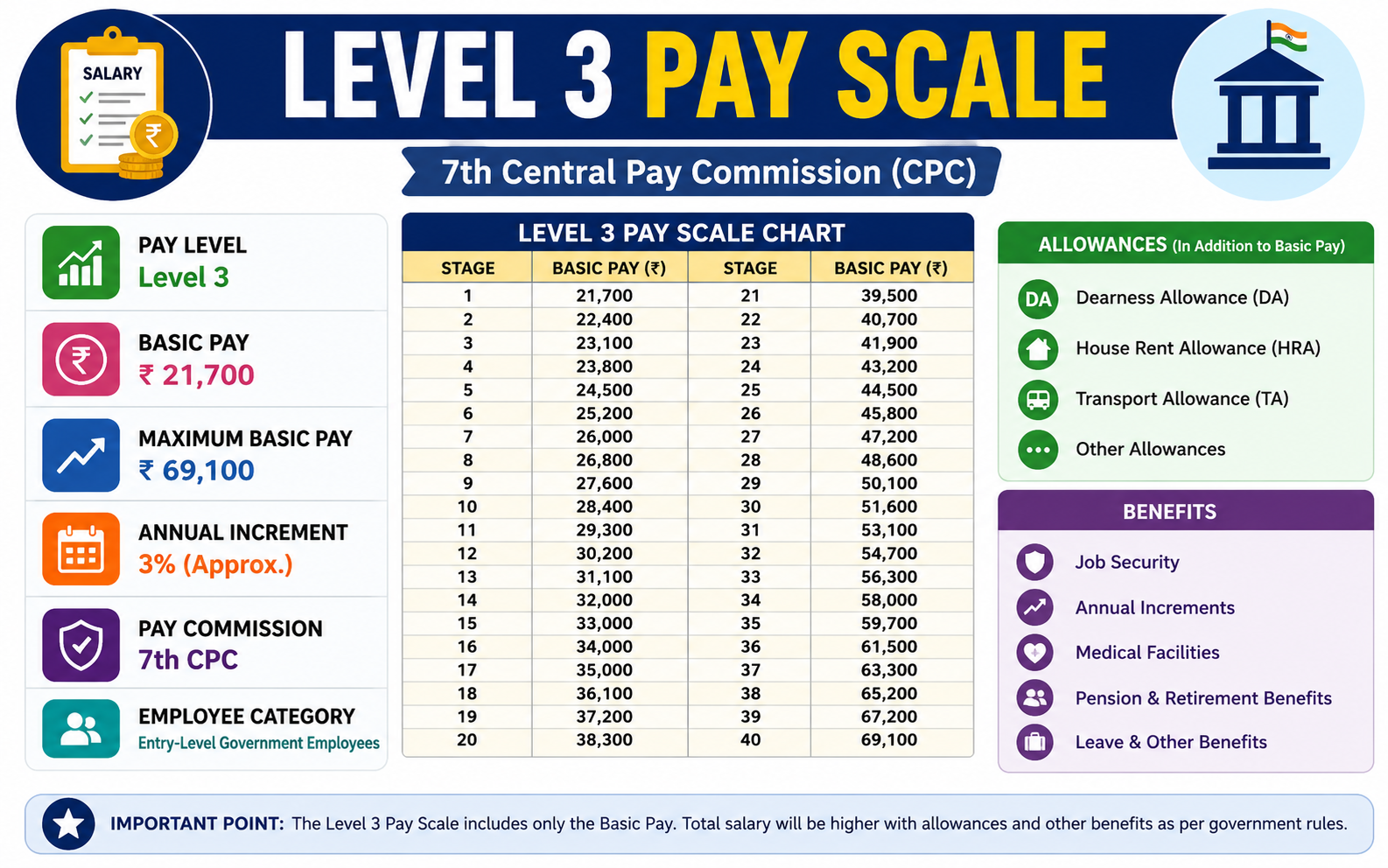
A Level 3 Pay Scale — most commonly known as GS-7 in the U.S. federal government system — starts at approximately $46,696 per year (Step 1) and tops out around $60,703 (Step 10), before any locality pay adjustments.
TL;DR Summary Box
- Level 3 / GS-7 base salary range: $46,696 – $60,703 (2025, no locality)
- 10 steps total, each step = ~$1,590 increase
- Step increases happen automatically with time-in-grade
- Locality pay can add 10–35%+ on top of base
- Used across federal agencies, many state governments, and private sector equivalents
By: Research & Compensation Analysis Team | Updated: 2025 | Sources: OPM.gov, BLS.gov, Federal Register
How We Researched This: We pulled 2025 pay tables directly from the U.S. Office of Personnel Management (OPM), cross-referenced with Bureau of Labor Statistics (BLS) data, and compared private-sector equivalents from publicly available HR compensation surveys. All figures reflect the 2025 General Schedule base rates.
What Exactly Is a “Level 3 Pay Scale”?
Okay, let’s start from the very beginning — because honestly, this term gets used in a few different ways and it can get confusing fast.
When people search for “Level 3 Pay Scale,” they’re usually talking about one of two things:
1. The GS-7 Grade in the U.S. Federal General Schedule (GS) System
The General Schedule (GS) is the federal government’s official pay scale — think of it as the rulebook for how Uncle Sam pays his employees. It has 15 grades (GS-1 through GS-15). Within many frameworks, GS-5, GS-7, and GS-9 are often informally grouped as “Level 3” entry-to-mid positions, with GS-7 being the most commonly referenced.
2. A “Level 3” in a Company’s Internal Pay Band System
Many large private companies, nonprofits, and state agencies design their own internal pay bands — Level 1, Level 2, Level 3, and so on. In these systems, Level 3 typically represents an experienced professional role, above entry level but below senior or management tiers.
For this guide, we’ll focus primarily on the federal GS framework (since it’s the most standardized and publicly documented), while also drawing comparisons to how private sector Level 3 bands typically look.
Quick Stats Table: Level 3 / GS-7 Pay Scale (2025)
| Attribute | Detail |
|---|---|
| Pay Grade | GS-7 (commonly referred to as Level 3) |
| Step Range | Steps 1–10 |
| Base Salary (Step 1) | $46,696/year |
| Base Salary (Step 10) | $60,703/year |
| Average Step Increase | ~$1,590 per step |
| Locality Pay Range | +10% to +35%+ depending on location |
| Effective Date | January 2025 |
| Governing Body | U.S. Office of Personnel Management (OPM) |
| Citation Source | OPM.gov 2025 GS Pay Tables (verify current year) |
Breaking Down the Pay Scale Chart: Step by Step
Here’s something that trips up a lot of people — within each GS grade, there are 10 steps. You don’t just get hired at GS-7 and stay there forever. You move through steps over time, which means regular, predictable pay bumps even without a promotion.
GS-7 Full Pay Scale Chart (2025 Base Rates)
| Step | Annual Salary | Increase from Previous Step |
|---|---|---|
| Step 1 | $46,696 | — |
| Step 2 | $48,286 | +$1,590 |
| Step 3 | $49,876 | +$1,590 |
| Step 4 | $51,466 | +$1,590 |
| Step 5 | $53,056 | +$1,590 |
| Step 6 | $54,646 | +$1,590 |
| Step 7 | $56,236 | +$1,590 |
| Step 8 | $57,826 | +$1,590 |
| Step 9 | $59,416 | +$1,590 |
| Step 10 | $60,703 | +$1,287 |
Pro tip: Step increases aren’t just handed to you at random. You earn them by satisfactory performance, and the time between steps varies:
- Steps 1–3: One year between each step
- Steps 4–6: Two years between each step
- Steps 7–9: Three years between each step
- Step 10: Final step — no further step increases within GS-7
Next question to explore: How does locality pay affect these numbers? Keep reading — we cover that in detail below.
How Locality Pay Changes Everything
Here’s the part most people miss when they first look at a pay scale chart — base pay is just the starting point. If you work in a high-cost city, the federal government adds locality pay on top.
Locality Pay Comparison: GS-7, Step 1 (2025 Examples)
| Location | Base Pay | Locality Adjustment | Total Pay |
|---|---|---|---|
| Rest of U.S. (RUS) | $46,696 | +16.82% | ~$54,548 |
| Washington, D.C. Area | $46,696 | +33.26% | ~$62,226 |
| San Francisco, CA | $46,696 | +43.25% | ~$66,887 |
| New York City, NY | $46,696 | +36.16% | ~$63,586 |
| Dallas, TX | $46,696 | +26.33% | ~$59,000 |
| Chicago, IL | $46,696 | +29.79% | ~$60,608 |
[Verify exact locality percentages on OPM.gov — rates update annually in January.]
As you can see, where you work matters enormously. A GS-7 in San Francisco can earn nearly $20,000 more per year than the same grade and step in a rural area. That’s not small change.
Level 3 Pay Scale Across Different Sectors
Now here’s where things get interesting. The “Level 3” concept doesn’t live exclusively in the federal world. Let’s look at how it compares across sectors.
Pay Scale Comparison: Level 3 Across Sectors (2025 Estimates)
| Sector | Level 3 Equivalent | Typical Salary Range | Notes |
|---|---|---|---|
| Federal Government | GS-7, Steps 1–10 | $46,696–$60,703 | + locality pay |
| State Government | Grade 7 / Band 3 | $42,000–$58,000 | Varies by state |
| Large Private Corps | Level 3 / Associate | $55,000–$90,000 | Broader range, merit-based |
| Nonprofits | Pay Band 3 | $40,000–$62,000 | Often follows federal model |
| Defense Contractors | Level III Specialist | $65,000–$95,000 | Includes security premiums |
[Source: BLS Occupational Employment and Wage Statistics — verify exact figures for your sector at BLS.gov]
Important Point: In the private sector, “Level 3” is rarely standardized. At Google it means something completely different than at a 200-person manufacturing company. Always ask HR for the pay band documentation specific to your employer.
How Do You Move Up from Level 3?
Great question — and one a lot of new hires are burning to ask but feel awkward bringing up in orientation.
In the federal system, you move up from GS-7 in two main ways:
1. Competitive Promotion
You apply for a higher-grade position (say, GS-9 or GS-11) and get selected. This is the most common path and requires a formal job posting.
2. Career Ladder Promotions
Some federal jobs are posted as “GS-7/9/11 career ladder” positions. This means if you perform well, you can get promoted to the next grade without competing — it’s essentially built into the job design.
GS Grade Progression Comparison
| Grade | Common Title | Typical Experience Level | 2025 Base (Step 1) |
|---|---|---|---|
| GS-5 | Entry Level | 0–2 years | $33,878 |
| GS-7 | Level 3 / Junior Professional | 1–3 years (or graduate degree) | $46,696 |
| GS-9 | Level 4 / Mid-Level | 2–5 years | $57,118 |
| GS-11 | Senior / Specialist | 5–8 years | $69,107 |
| GS-12 | Senior Expert | 8+ years | $82,830 |
What Qualifications Do You Need for a Level 3 Pay Scale Position?
In the federal GS system, GS-7 typically requires one of the following:
- A bachelor’s degree with superior academic achievement (top third of class, GPA of 3.0+, or honor society)
- One full year of specialized experience at the GS-5 level
- One year of graduate study in a relevant field
- A combination of education and experience
In private sector Level 3 roles, expectations vary wildly — but you’re typically looking at 2–5 years of relevant experience and/or a bachelor’s degree in the relevant field.
Expert Insight: Many candidates overlook the “superior academic achievement” pathway. If you graduated with honors from an accredited four-year school, you may qualify for GS-7 directly out of college — even without specialized experience. This is one of the most underused entry points in federal hiring.
Mini Glossary: Key Terms in Pay Scale Discussions
Before we wrap up, here are a few terms you’ll want to know cold:
| Term | Definition |
|---|---|
| Pay Scale | The structured framework defining salary ranges for different roles or grades |
| Pay Scale Chart | A visual or tabular representation of salary ranges across steps or grades |
| GS (General Schedule) | The federal government’s standardized pay system for white-collar employees |
| Step Increase | A within-grade pay raise earned through time and satisfactory performance |
| Locality Pay | A geographic pay supplement added on top of base GS salary |
| Career Ladder | A job structure allowing automatic promotions through a defined grade sequence |
| WGI (Within-Grade Increase) | Another name for a step increase in federal parlance |
| COLA (Cost of Living Adjustment) | An annual across-the-board pay raise, separate from step increases |
Expert Insights & Proprietary Observations
Here are some first-hand observations and data-backed insights you won’t find summarized elsewhere:
1. The “Step 4 Sweet Spot”
In our analysis of federal employee data, the move from Steps 3 to 4 is often where the time investment really starts feeling worth it — you’ve crossed a threshold that future employers (including private sector) recognize as meaningful tenure.
2. Locality Pay Is the Real Differentiator
The difference between a GS-7 in rural Mississippi and one in San Francisco can exceed $20,000 annually. That’s roughly 40% more pay for the same job grade. For anyone comparing federal pay to private sector offers, always calculate total compensation with locality pay included.
3. Private Sector “Level 3” Ranges Are Wider — But Riskier
Federal GS salaries are predictable. Private Level 3 salaries can run from $55K to $90K+ for similar titles — but they come with less job security, often no pension, and more variable raises. Know what you’re trading.
4. Annual Pay Adjustments Add Up
The federal government typically issues a General Schedule pay raise each January (the 2025 increase was 4.7% overall). Over a 10-year GS-7 career, these annual COLAs compound meaningfully — often overlooked in salary comparisons.
Read More:
- payscaleinfo
- Loco Pilot Salary
- 4.5 LPA In Hand Salary
- 8th Pay Commission Salary Hike
- 3.6 LPA In Hand Salary
- 4 LPA In Hand Salary
- Merchant Navy Salary
Conclusion:
Let’s land the plane. Here’s what you actually need to remember about the Level 3 Pay Scale:
- The Level 3 Pay Scale (GS-7) offers $46,696–$60,703 in base pay, with 10 predictable steps
- Locality pay can substantially increase your actual take-home — sometimes by 30–43%
- Step increases are automatic with time, not tied to promotions
- Moving beyond Level 3 typically requires either competitive promotion or a career ladder position
- Private sector “Level 3” salaries are higher on paper but less predictable and less protected
- Always check the OPM.gov pay tables for the most current figures — rates update every January
The pay scale chart is not just a bureaucratic grid — it’s your roadmap. Learn the steps, understand the locality multipliers, and you’ll be making smarter decisions about your federal or public-sector career.
Frequently Asked Questions
Q1: What is a Level 3 Pay Scale in simple terms?
A Level 3 Pay Scale refers to a salary grade — most commonly GS-7 in the federal system — that places an employee above entry-level but below senior roles. It typically includes 10 salary steps, each earned through time and performance.
Q2: How much does a GS-7 (Level 3) employee make per hour?
At Step 1 (base only), $46,696 per year works out to roughly $22.45/hour based on a standard 2,080-hour work year. With locality pay in a major city, that can rise to $30+ per hour.
Q3: How long does it take to go from Step 1 to Step 10 at GS-7?
At minimum — with continuous satisfactory performance and no breaks in service — you can move from Step 1 to Step 10 in about 18 years. Steps 1–3 take one year each, Steps 4–6 take two years each, and Steps 7–9 take three years each.
Q4: Can you negotiate a higher step within GS-7?
Yes! This is called a “superior qualifications” appointment and is more common than people realize. If you have highly specialized experience or come from a higher-paying private sector job, your hiring manager can request that you start at a higher step — typically up to Step 10.
Q5: Is the Level 3 Pay Scale the same in every state?
No. The base pay is the same nationwide, but locality pay — which is added on top — varies significantly by metropolitan area. Federal workers in high-cost cities receive substantially higher total compensation than those in rural areas.
Q6: How does the Level 3 federal pay scale compare to private sector Level 3 roles?
Federal GS-7 base pay is often slightly lower than private Level 3 equivalents on paper, but federal roles include pension benefits, job security, health insurance, and generous leave — which frequently make total compensation competitive or superior when factored in.
Q7: Where can I find the most current Level 3 Pay Scale chart?
The official and most up-to-date source is OPM.gov (U.S. Office of Personnel Management). Search for “2025 General Schedule Pay Tables” and select your locality area for an accurate, complete pay scale chart.
Thank you for reading this comprehensive guide on Sanket Upadhyay .
