

The 8th Pay Commission salary hike is expected to raise minimum basic pay from ₹18,000 to anywhere between ₹41,000 and ₹58,500, depending on the fitment factor finally approved — which could range between 2.28x and 3.25x. The effective date is January 1, 2026, but actual revised pay slips will likely arrive in 2026–27, with arrears paid from January 1, 2026.
8th Pay Commission at a Glance
| Parameter | Details |
|---|---|
| Commission Name | 8th Central Pay Commission (8th CPC) |
| Date of Constitution | January 16, 2025 (in-principle); October 28, 2025 (formal ToR approved) |
| Chairperson | Justice Ranjana Prakash Desai (Retd. Supreme Court Judge) |
| Part-Time Member | Prof. Pulak Ghosh, IIM Bengaluru |
| Member Secretary | Pankaj Jain (Petroleum & Natural Gas Secretary) |
| Effective Date (Expected) | January 1, 2026 [CONFIRMED target] |
| Report Submission Deadline | 18 months from November 3, 2025 (approx. mid-2027) |
| Employees Covered | ~50 lakh Central Government Employees |
| Pensioners Covered | ~65–69 lakh Pensioners |
| Expected Salary Hike | 30%–40% (Estimates) |
| Expected Fitment Factor Range | 2.28x – 3.25x (Expert estimates; unions demand up to 3.68x) |
| Current Minimum Basic Pay (7th CPC) | ₹18,000 |
| Expected Minimum Basic Pay | ₹41,000 – ₹58,500 (Estimates) |
| Current DA (as of April 2026) | 60% [CONFIRMED] |
⚠️ Disclaimer: Salary figures above — except those marked [CONFIRMED] — are expert projections based on analyst research, employee union submissions, and historical pay commission trends. The 8th CPC has NOT submitted its final report as of July 2026. All figures are subject to change upon official government notification.
So, What Exactly Is the 8th Pay Commission Salary Hike?
Let’s be real for a second. Every time a Pay Commission comes around, the internet explodes with numbers — some scary-small, some suspiciously large. So what’s actually happening?
Here’s the simple version: Every 10 years, the Government of India sets up a Pay Commission to look at what central government employees (teachers, army officers, clerks, scientists, and everyone in between) are earning — and decide if it’s time for a raise. The 8th Pay Commission Salary Hike is that raise for the current decade.
The 8th Pay Commission was officially constituted on January 16, 2025 (in-principle) and got its Terms of Reference approved on October 28, 2025 under the leadership of Justice Ranjana Prakash Desai, a retired judge of the Supreme Court of India. The commission is expected to benefit roughly 50 lakh serving employees and 65–69 lakh pensioners across India.
Now, the big burning question — when will the money actually hit your account? The target effective date is January 1, 2026, but don’t hold your breath for revised pay slips just yet. The commission has 18 months from November 2025 to submit its report, which means actual implementation could realistically happen in 2026–27, with arrears paid back to January 2026.
What Is the Fitment Factor — And Why Should You Care?
Think of the fitment factor as the magic multiplier for your salary. It’s the number the government uses to calculate your new basic pay from your old basic pay.
Formula: New Basic Pay = Current Basic Pay × Fitment Factor
So if your basic pay is ₹20,000 right now, and the fitment factor comes in at 2.5, your new basic pay becomes ₹50,000. Simple.
Here’s how it played out in history, for context:
| Pay Commission | Fitment Factor | Old Minimum Pay | New Minimum Pay |
|---|---|---|---|
| 6th Pay Commission (2006) | 1.86x | ₹2,750 | ₹7,000 |
| 7th Pay Commission (2016) | 2.57x | ₹7,000 | ₹18,000 |
| 8th Pay Commission (Expected 2026) | 2.28x – 3.25x | ₹18,000 | ₹41,000 – ₹58,500 |
The 7th Pay Commission used a fitment factor of 2.57x — so many analysts use that as the conservative baseline for the 8th CPC estimates too. But employee unions? They’re demanding much more — some as high as 3.68x to 3.83x, which would push minimum basic pay close to ₹69,000.
The realistic sweet spot, according to most financial analysts, is somewhere between 2.28x and 2.86x.
8th Pay Commission Salary Hike 2026 — Level-Wise Pay Matrix Estimates
Here’s what your salary could look like across pay levels, using a 2.57x fitment factor (conservative, most-likely baseline):
| Pay Level (7th CPC) | Current Basic Pay | Expected New Pay (2.57x) | Expected New Pay (3.0x) |
|---|---|---|---|
| Level 1 (MTS/Group D) | ₹18,000 | ₹46,260 | ₹54,000 |
| Level 4 (Clerk/LDC) | ₹25,500 | ₹65,535 | ₹76,500 |
| Level 6 (Assistant) | ₹35,400 | ₹90,978 | ₹1,06,200 |
| Level 7 (Inspector/SO) | ₹44,900 | ₹1,15,393 | ₹1,34,700 |
| Level 10 (Gazetted Officer) | ₹56,100 | ₹1,44,177 | ₹1,68,300 |
| Level 13 (Joint Secretary) | ₹1,23,100 | ₹3,16,367 | ₹3,69,300 |
| Level 17 (Cabinet Secretary) | ₹2,50,000 | ₹6,42,500 | ₹7,50,000 |
8th Pay Commission Salary Calculator — How to Estimate Your Own Hike
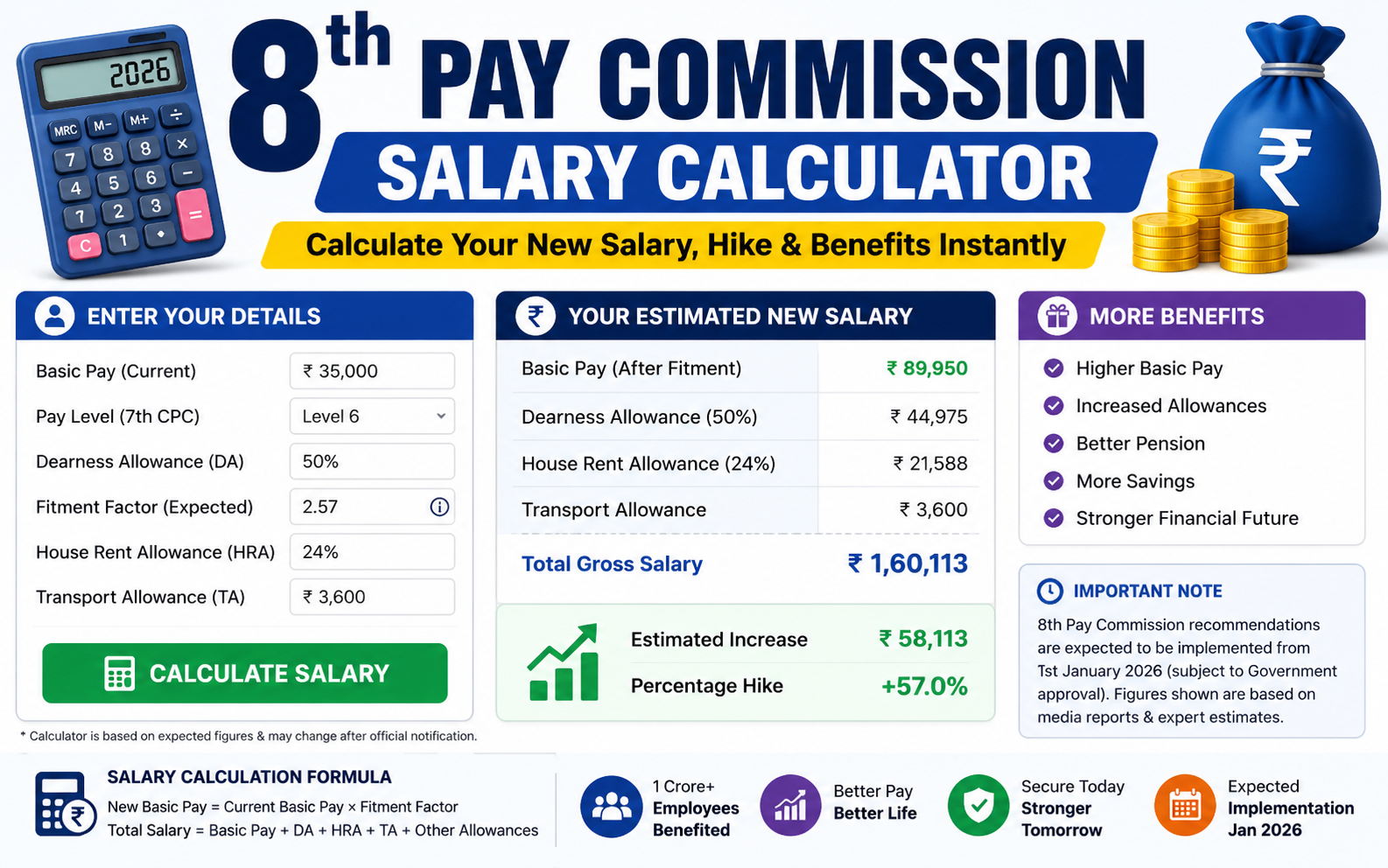
You don’t need a fancy tool for this. Here’s your quick DIY 8th Pay Commission Salary Calculator:
Step 1: Note your current 7th CPC basic pay.
Step 2: Add your current DA (60% as of now): Revised Base = Basic Pay + (Basic Pay × 60%)
Step 3: Apply the expected fitment factor to your current basic pay: New Basic Pay = Current Basic Pay × Fitment Factor
Step 4: Compare the two — whichever is higher is likely the floor of your new pay.
Example Calculation:
- Current Basic Pay: ₹35,400
- DA at 60%: ₹21,240
- Total effective pay now: ₹56,640
- At 2.57x fitment: New Basic = ₹90,978
- At 3.0x fitment: New Basic = ₹1,06,200
The 8th Pay Commission Salary Increase in this example ranges from ₹34,338 to ₹49,560 just in basic pay — before HRA, TA, and other allowances kick in.
What Are Employee Unions Demanding?
The central government employee unions aren’t shy about what they want. When the National Council (Staff Side) under the Joint Consultative Machinery (JCM) met in February 2026 in New Delhi, they put forward some pretty ambitious demands:
| Demand | Current (7th CPC) | What Unions Want |
|---|---|---|
| Fitment Factor | 2.57x | 3.25x – 3.68x |
| Annual Increment | 3% | 7% |
| Leave Encashment at Retirement | 300 days | 400 days |
| Fixed Medical Allowance | ₹1,000/month | ₹20,000/month |
| Family Unit for Salary Calculation | 3 members | 5 members |
| Leave Travel Concession | In kind | Cash payment |
Whether the government will meet all these demands is anyone’s guess — but historically, the final recommendations tend to land somewhere between the union demands and the government’s fiscal comfort zone.
Pension Hike Under 8th Pay Commission — What Retirees Can Expect
If you’re a pensioner, you’re not left out of this party. The 8th Pay Commission Salary and Pension Hike will affect you too, since pensions are based on basic pay.
| Pension Category | Current Amount | Expected at 2.57x | Expected at 3.83x |
|---|---|---|---|
| Minimum Pension | ₹9,000 | ~₹23,130 | ~₹34,470 |
| Family Pension (Basic) | ₹4,500 | ~₹11,565 | ~₹17,235 |
When Will the 8th Pay Commission Salary Actually Come?
This is probably the question keeping every government employee up at night — “Sir, salary kab aayegi?”
Here’s a realistic timeline:
| Milestone | Date |
|---|---|
| In-principle approval | January 16, 2025 |
| Terms of Reference approved | October 28, 2025 |
| Commission formally constituted | November 3, 2025 |
| Report submission deadline | ~May 2027 (18 months from Nov 2025) |
| Government review & approval | 2027 |
| Expected implementation | 2027 (with arrears from Jan 1, 2026) |
The most important takeaway here? Even if you don’t get the revised salary in January 2026, you WILL get arrears. Every single rupee from January 1, 2026 to actual implementation date gets paid as a lump sum. Think of it as a forced piggy bank the government is filling on your behalf.
8th Pay Commission Salary Hike Predictions — What Analysts Say vs. What Unions Want
Let’s break down the spectrum of 8th Pay Commission Salary Hike Predictions:
| Scenario | Fitment Factor | Minimum Basic Pay | Who’s Saying This |
|---|---|---|---|
| Conservative (Fiscal-first) | 1.92x – 2.10x | ₹34,560 – ₹37,800 | Fiscal analysts, RBI-aligned estimates |
| Moderate (Most Likely) | 2.28x – 2.57x | ₹41,040 – ₹46,260 | Most independent analysts |
| Optimistic | 2.86x – 3.25x | ₹51,480 – ₹58,500 | Employee unions, public sector experts |
| Aggressive (Union Demand) | 3.68x – 3.83x | ₹66,240 – ₹68,940 | Staff Side, JCM demands |
What About HRA and Other Allowances?
Basic pay is just the starting point. Once the 8th Pay Commission Salary Structure is implemented, other allowances will be recalculated too:
- HRA (House Rent Allowance): Calculated as a % of revised basic pay — so it goes up automatically.
- TA (Travel Allowance): Also linked to basic pay — rises with it.
- DA (Dearness Allowance): Resets to 0% on the new basic pay after implementation (as has happened with every past commission). Then starts climbing again from 0.
- NPS/Gratuity: Both get revised upward since they’re linked to basic pay.
The net effect? Total take-home salary could rise by 40–50% when all allowances are factored in — not just the 30–34% basic pay hike.
8th Pay Commission Salary Hike India — Impact on State Government Employees
Here’s something many people miss: the 8th CPC directly covers only central government employees. But historically, most state governments follow the central pay commission’s lead within 1–3 years of central implementation.
So if you work for a state government — teachers, police, clerks — your 8th Pay Commission Salary Increase 2026 won’t come automatically, but there’s a very good chance your state government will announce a similar revision in 2027–2028.
LPA to In-Hand Salary — Quick Reference Table
Now that you have a sense of what the 8th Pay Commission Salary Hike could mean in terms of revised basic pay, here’s something equally useful — a general reference table showing how annual salary packages (in LPA) translate to approximate monthly and yearly in-hand amounts. This is especially handy if you’re trying to map your revised CTC or package to actual take-home pay.
⚠️ Important Note: These figures are for general informational purposes only. Actual in-hand salary depends on your tax slab, HRA exemption, PF deduction, professional tax, and other individual factors. Use this only as a broad reference — not as a precise calculation. Source reference: jupiter.money salary calculator.
| Annual Salary (LPA) | Monthly In-Hand Range | Yearly In-Hand Range |
|---|---|---|
| 1 LPA | ₹7,600 – ₹8,300 | ₹91,600 – ₹1,00,000 |
| 1.5 LPA | ₹11,500 – ₹12,500 | ₹1,38,600 – ₹1,50,000 |
| 2 LPA | ₹15,500 – ₹16,600 | ₹1,85,600 – ₹1,97,600 |
| 2.3 LPA | ₹17,817 – ₹19,100 | ₹2,13,000 – ₹2,27,600 |
| 3 LPA | ₹23,300 – ₹25,000 | ₹2,79,600 – ₹2,97,600 |
| 3.8 LPA | ₹29,500 – ₹31,400 | ₹3,54,800 – ₹3,77,600 |
| 3.9 LPA | ₹30,350 – ₹32,300 | ₹3,64,200 – ₹3,87,600 |
| 4 LPA | ₹31,100 – ₹33,133 | ₹3,73,600 – ₹3,97,600 |
| 4.5 LPA | ₹34,900 – ₹37,200 | ₹4,18,800 – ₹4,46,400 |
| 5 LPA | ₹38,900 – ₹41,400 | ₹4,67,600 – ₹4,97,600 |
| 5.5 LPA | ₹42,800 – ₹45,600 | ₹5,14,600 – ₹5,47,600 |
| 6 LPA | ₹45,500 – ₹49,800 | ₹5,61,600 – ₹5,97,600 |
| 7 LPA | ₹51,000 – ₹54,600 | ₹6,12,000 – ₹6,55,200 |
| 8 LPA | ₹57,200 – ₹62,400 | ₹6,87,400 – ₹7,49,600 |
| 8.5 LPA | ₹60,400 – ₹66,384 | ₹7,24,800 – ₹7,96,600 |
| 9 LPA | ₹63,600 – ₹70,300 | ₹7,63,200 – ₹8,43,600 |
| 9.2 LPA | ₹64,900 – ₹71,800 | ₹7,74,800 – ₹8,62,400 |
| 9.5 LPA | ₹66,800 – ₹73,700 | ₹8,00,000 – ₹8,84,900 |
| 9.6 LPA | ₹67,400 – ₹74,400 | ₹8,08,000 – ₹8,93,000 |
| 9.8 LPA | ₹68,700 – ₹75,700 | ₹8,24,400 – ₹9,09,000 |
| 10 LPA | ₹70,000 – ₹77,000 | ₹8,40,000 – ₹9,25,000 |
| 11 LPA | ₹76,300 – ₹76,300 | ₹9,15,600 – ₹10,05,000 |
| 11.5 LPA | ₹79,300 – ₹87,100 | ₹9,51,600 – ₹10,45,300 |
| 12 LPA | ₹82,000 – ₹90,400 | ₹9,84,000 – ₹10,85,400 |
| 13 LPA | ₹87,600 – ₹97,100 | ₹10,51,200 – ₹11,65,800 |
| 13.5 LPA | ₹90,300 – ₹1,00,400 | ₹10,83,600 – ₹12,05,700 |
| 14 LPA | ₹93,100 – ₹1,03,800 | ₹11,17,200 – ₹12,45,800 |
| 15 LPA | ₹98,600 – ₹1,10,500 | ₹11,83,200 – ₹13,26,000 |
| 16 LPA | ₹1,04,100 – ₹1,17,100 | ₹12,49,200 – ₹14,06,200 |
| 16.5 LPA | ₹1,06,900 – ₹1,20,500 | ₹12,82,800 – ₹14,46,800 |
| 17 LPA | ₹1,09,700 – ₹1,23,700 | ₹13,16,400 – ₹14,84,400 |
| 17.5 LPA | ₹1,12,400 – ₹1,26,700 | ₹13,48,800 – ₹15,21,000 |
| 18 LPA | ₹1,15,200 – ₹1,29,800 | ₹13,82,400 – ₹15,57,700 |
| 19 LPA | ₹1,20,700 – ₹1,35,900 | ₹14,48,400 – ₹16,31,000 |
| 20 LPA | ₹1,26,200 – ₹1,42,000 | ₹15,14,400 – ₹17,04,300 |
| 21 LPA | ₹1,31,800 – ₹1,48,100 | ₹15,81,600 – ₹17,77,600 |
| 22 LPA | ₹1,37,300 – ₹1,54,200 | ₹16,47,600 – ₹18,50,900 |
| 22.5 LPA | ₹1,40,100 – ₹1,57,200 | ₹16,81,200 – ₹18,87,500 |
| 24 LPA | ₹1,48,300 – ₹1,66,400 | ₹17,79,600 – ₹19,97,500 |
| 26 LPA | ₹1,59,400 – ₹1,78,600 | ₹19,12,800 – ₹21,44,100 |
| 28 LPA | ₹1,70,500 – ₹1,90,800 | ₹20,46,000 – ₹22,90,700 |
| 30 LPA | ₹1,81,500 – ₹2,03,100 | ₹21,78,000 – ₹24,37,300 |
| 34 LPA | ₹2,03,600 – ₹2,27,500 | ₹24,43,200 – ₹27,30,500 |
| 35 LPA | ₹2,09,100 – ₹2,33,600 | ₹25,09,200 – ₹28,03,800 |
| 36 LPA | ₹2,14,700 – ₹2,39,700 | ₹25,76,400 – ₹28,77,100 |
| 37 LPA | ₹2,20,200 – ₹2,45,800 | ₹26,42,400 – ₹29,50,420 |
| 40 LPA | ₹2,36,800 – ₹2,64,100 | ₹28,41,600 – ₹31,70,300 |
| 45 LPA | ₹2,64,400 – ₹2,94,735 | ₹31,72,800 – ₹35,36,800 |
| 85 LPA | ₹4,66,000 – ₹5,39,000 | ₹55,92,000 – ₹64,68,800 |
| 90 LPA | ₹4,92,500 – ₹5,69,600 | ₹59,10,000 – ₹68,35,300 |
| 1 Crore per annum | ₹5,45,100 – ₹6,30,600 | ₹65,41,200 – ₹75,68,300 |
Glossary — Key Terms Explained Simply
Fitment Factor: A multiplier to calculate your new salary from the old one.
Pay Matrix: A table showing salaries for every pay level and increment year — think of it as the official salary chart.
DA (Dearness Allowance): Extra pay to compensate for inflation — currently 60% of basic pay.
Arrears: The unpaid salary difference between the old pay and new pay, paid as a lump sum after implementation.
HRA (House Rent Allowance): Subsidy for renting a house, calculated as a percentage of basic pay.
7th CPC: The previous Pay Commission (2016), the baseline from which 8th CPC revisions are being calculated.
Conclusion — Key Takeaways
If you’ve read this far, here’s what you need to walk away with:
- The 8th Pay Commission Salary Hike is real and substantial — minimum 30%, potentially 40%+ in total effective pay.
- The effective date is January 1, 2026, but revised pay slips will come only after the report is approved — likely 2027.
- Arrears will be paid from January 2026 to the date of actual implementation — no money is lost.
- The fitment factor is the key number — most analysts expect 2.57x to 2.86x; unions want up to 3.68x.
- Pensioners benefit too — minimum pension could jump from ₹9,000 to ₹23,000–₹35,000.
- Nothing is confirmed yet — the commission is still in consultation as of July 2026. Final figures will emerge with the official report.
Read More:
Frequently Asked Questions
Q1. When will the 8th Pay Commission salary hike actually be implemented?
The target effective date is January 1, 2026. However, since the commission has until approximately May 2027 to submit its report, actual revised salaries may not arrive until late 2027. Arrears will be paid from January 2026.
Q2. What is the expected fitment factor under the 8th Pay Commission?
Most analysts project a fitment factor between 2.28x and 2.86x. Employee unions are demanding up to 3.68x. The final number will be in the commission’s official report.
Q3. How do I use the 8th Pay Commission Salary Calculator?
Multiply your current basic pay by the expected fitment factor. Example: ₹35,400 × 2.57 = ₹90,978 new basic pay. Add allowances for total take-home estimate. This is an estimate — final figures depend on the official pay matrix.
Q4. Will pension also increase under the 8th Pay Commission?
Yes. Pensioners will receive revised pension based on the new pay matrix and fitment factor. The minimum pension could rise from ₹9,000 to ₹23,000–₹34,500, depending on the approved fitment factor.
Q5. Will I get arrears if the salary is delayed beyond January 2026?
Yes. Since the effective date is January 1, 2026, any delay in implementation will result in arrears — the difference between old and new pay — being paid as a lump sum once the revised structure is notified.
Q6. Does the 8th Pay Commission cover state government employees?
Not directly. The 8th CPC covers central government employees and defence personnel. State governments typically follow with their own revisions within 1–3 years, based on the central commission’s recommendations.
Q7. Where can I check official updates on the 8th Pay Commission?
Visit the official portal at 8cpc.gov.in or the Department of Expenditure website for the latest verified information. Always cross-check salary figures with official notifications before making financial decisions.
Thank you for reading this comprehensive guide on Salarybatao
